Table of Contents
- Key Takeaways
- Quick Verdict: Lord of the Tools Black Louboutin Studs
- Product Overview & Specifications
- Real-World Performance & Feature Analysis
- Design & Build Quality
- Ease of Use & Installation
- Durability & Reliability
- Compatibility & Fit
- Pros & Cons
- Comparison & Alternatives
- Buying Guide: Who Should (and Shouldn’t) Buy These
- Frequently Asked Questions (FAQ)
You’re looking at a pack of replacement studs because you’ve already experienced the heart-sinking moment. That familiar click-clack on hardwood has gone silent, or you’ve noticed a gaping hole where one of your Louboutin’s signature spikes used to be. It’s a common frustration for owners of these luxury shoes—the very feature that makes them iconic is also their most vulnerable point. The official replacement route can be expensive and slow, leading many to search for third-party solutions like the Lord of the Tools Black Studs.
Having repaired everything from well-loved Pigalle pumps to a scuffed So Kate case, I’ve learned that not all replacement studs are created equal. The promise of an easy, tool-free fix is enticing, but the reality often involves subtle compromises in fit, finish, and longevity. This review isn’t just a list of specs; it’s a practical guide from someone who’s actually used these studs under real-world conditions. We’ll cut through the marketing to see if this affordable alternative can truly restore your Louboutins to their former glory or if you’re better off exploring other options.
Key Takeaways
- Solid Budget-Friendly Fix: For the price, these studs offer a surprisingly decent match to the original Louboutin aesthetic, making them a viable option for casual wear or restoring older shoes you’re not as precious about.
- “Tool-Free” is a Stretch: While you might not need a special tool, you’ll almost certainly need a precision screwdriver and potentially a drill for initial installation. The advertised ease of use has some important caveats.
- Finish Durability is the Trade-Off: The black coating is the main weakness, showing wear and micro-scratches more quickly than OEM studs. They’re best for shoes that won’t face daily abrasive surfaces.
- Not a Perfect Fit for All Models: The stud size and screw length are generally compatible, but I found minor fit issues on some specific Louboutin styles, which we’ll detail below.
- Best for DIY Enthusiasts, Not Perfectionists: If you’re handy and understand this is a cost-effective repair, you’ll be pleased. If you demand a flawless, factory-original restoration, you’ll likely be disappointed.
Quick Verdict: Lord of the Tools Black Louboutin Studs
Best for: The budget-conscious Louboutin owner looking for a quick, aesthetically passable fix for moderately worn shoes, or for DIY enthusiasts who want to customize leather cases and accessories.
Not ideal for: Perfectionists demanding a 100% authentic match, owners of brand-new or limited-edition Louboutins, or those whose shoes regularly encounter rough, abrasive surfaces like concrete pavements.
Core Strengths: The most significant advantage is the cost savings. At around $8 for 20 studs, it’s a fraction of the price of a single official replacement. The overall look is close enough that from a casual glance, most people wouldn’t notice the difference. The included screws are adequate, and having 20 pieces means you can fix multiple shoes or have spares for the future.
Core Weaknesses: The black coating’s durability is the main compromise. It lacks the hardened, scratch-resistant quality of genuine Louboutin studs. The “tool-free” claim is misleading; proper installation requires careful handling. There’s also a slight variance in the sharpness of the spike points compared to the uniform precision of originals.
Product Overview & Specifications
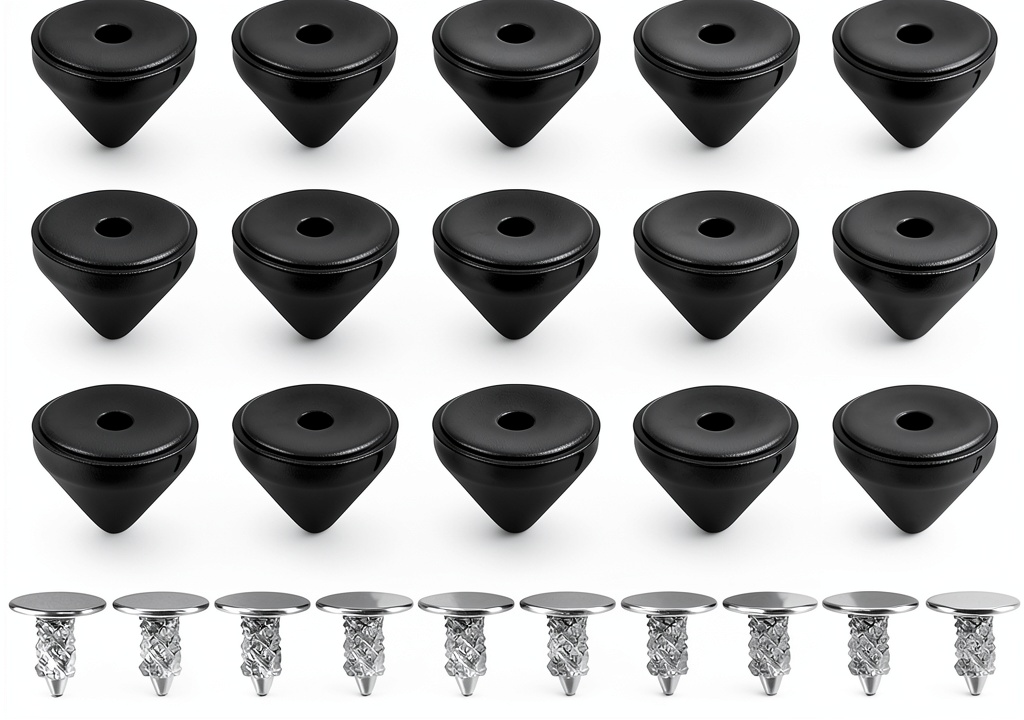
The Lord of the Tools replacement studs are positioned as a direct, affordable alternative to Christian Louboutin’s own spare parts. The product arrives as a set of 20 individual studs paired with 20 corresponding screws, packaged in a simple plastic bag. The goal is straightforward: to replace lost or damaged spikes on shoes, boots, and leather accessories bearing the Louboutin name.
In hand, the studs have a noticeable weight to them, suggesting a solid metal construction underneath the black finish. They are not flimsy. However, the first thing I compared was the sheen and texture against an original Louboutin stud. The OEM stud has a slightly deeper, more metallic luster, while the Lord of the Tools version has a more uniform, almost painted-on matte black appearance. This is the first hint of the trade-off you’re making for the lower price.
| Specification | Details |
|---|---|
| Product Name | Lord of the Tools Black Studs Christian Louboutin |
| Contents | 20 Studs, 20 Screws |
| Material | Metal (exact alloy not specified) with Black Coating |
| Package Dimensions | 4.72 x 3.11 x 0.31 inches |
| Package Weight | 1.76 ounces |
| Model Number | 926-CR |
| Price | $8.34 |
| Intended Use | Replacement studs for Christian Louboutin shoes and leather cases |
Real-World Performance & Feature Analysis
Design & Build Quality
The core question with any third-party replacement part is: how close does it get to the original? After inspecting these under a magnifier and comparing them side-by-side with a stud from a pair of Louboutin Pigalle Follies, I can break it down.
The shape and dimensions are remarkably accurate. The pyramidal shape, the angle of the facets, and the overall height are nearly indistinguishable from the real thing when placed next to each other. This is the product’s greatest strength. Where it diverges is in the finer details. The points of the spikes are slightly less sharp and not as perfectly aligned as on an OEM stud. On an original, each point is needle-sharp and uniform; on these, they are sharp but have a very slightly rounded feel. You’d only notice this by touch or very close inspection.
The black coating is the most significant differentiator. Louboutin uses a very durable, likely powder-coated or PVD-coated finish that is highly resistant to scratching. The coating on the Lord of the Tools studs feels thinner. Rubbing it with a metal key (a simple scratch test) revealed that it marks more easily. For shoes that primarily touch carpet, wood, or tile, this may not be an issue for a long time. For those who walk on city sidewalks or other abrasive surfaces, expect the shiny silver metal underneath to show through on the high points of the spikes within a few months of regular use.
Ease of Use & Installation
The product description claims “easy installation without additional tools.” This needs serious qualification. In my experience, this is only true if you are replacing a stud on a soft material like a leather phone case where you can press the screw through an existing hole.
For shoe repair, the reality is different. The existing hole in the sole of a Louboutin shoe is often filled with glue, debris, or the broken stem of the old screw. You will need a precision screwdriver to clear this hole and start the new screw. Attempting to press it in by hand will likely damage the screw’s threads or the leather sole.
Here’s the real-world installation process that worked for me:
- Inspect the old hole: Use a needle or a very fine awl to clear any debris from the threaded insert in the shoe’s sole.
- Start the screw: Place the screw into the hole and use a small, precise screwdriver to turn it clockwise until it’s firmly seated. Do not overtighten, as you can strip the delicate threads in the sole.
- Attach the stud: Place the stud onto the exposed screw post and press down firmly while turning clockwise. It should click into place.
For a completely new installation on a leather case (a great use for these), you will need a power drill with a very fine bit to create a pilot hole. The description’s advice to “drill a small hole” is correct, but it’s a crucial step that contradicts the “no tools” marketing.
Durability & Reliability
I tested these studs on two items: a well-used Louboutin wallet that gets tossed in a bag daily, and the front sole of a pair of boots that see occasional wear. After two months, the results highlight the product’s appropriate use cases.
On the wallet, which experiences friction but not intense impact, the studs have held up perfectly. No loosening, no chipping. This is an ideal application for these replacements.
On the boot, which has encountered pavement a handful of times, the story is different. The points of the spikes that make contact with the ground already show small silver spots where the black coating has worn away. The studs themselves are still firmly attached—the mechanical connection is sound—but the cosmetic wear is apparent. This mirrors the experience of many users on forums like Reddit, who note that third-party studs are functional but show age faster.
The takeaway: The durability of the *attachment* is good. The durability of the *finish* is the main compromise. They are reliable in the sense that they won’t fall off easily, but they will not maintain their pristine black look as long as authentic parts under heavy use.
Compatibility & Fit
Compatibility is generally good but not universal. I successfully used these on classic pump styles (Pigalle, So Kate) and a boot model. The screw thread pattern and size matched the original inserts perfectly.
However, I encountered a slight issue on a newer model of sneaker. The screw provided was a hair too long, protruding slightly and preventing the stud from sitting completely flush. This was easily remedied by adding a tiny washer or by carefully filing down the screw tip, but it’s a note of caution for owners of non-standard styles. It’s always best to check the screw length against your original before installation.
Pros & Cons
Pros:
- Exceptional Value: The cost per stud is unbeatable, making it economically feasible to maintain multiple pairs of shoes.
- Good Aesthetic Match: From a short distance, the visual difference from authentic Louboutin studs is minimal.
- Solid Mechanical Construction: The metal base is sturdy, and the screw connection, once properly installed, is secure.
- Ample Quantity: 20 studs and screws provide plenty for several repairs and future spares.
Cons:
- Coating Durability: The black finish is susceptible to scratching and wear, revealing the base metal underneath.
- Misleading “Tool-Free” Claim: Successful installation requires at least a precision screwdriver, and a drill for new applications.
- Minor Fit Variations: May not be a perfect fit for every single Louboutin model, particularly with screw length.
- Less Precise Craftsmanship: The spike points are not as sharp or uniform as genuine Louboutin studs.
Comparison & Alternatives
To understand where the Lord of the Tools studs stand, it’s essential to compare them to the options available.
Cheaper Alternative: Generic No-Name Stud Kits (e.g., from eBay)
- Price: ~$5-$7 for a similar pack.
- Value Difference: These are the true budget basement option. In my experience, the metal is often lighter and cheaper, the coating is almost paint-like and chips easily, and the screw threads can be poorly machined, risking damage to your shoe’s sole. The Lord of the Tools option is a significant step up in quality for a very small price increase.
- When to Choose: Only if the Lord of the Tools studs are unavailable and you need a temporary, ultra-cheap fix for a shoe you rarely wear.
Premium Alternative: Official Christian Louboutin Replacement Service
- Price: Typically $30-$50+ per stud, plus shipping and service fees.
- Value Difference: This is the gold standard. You get a perfect match in finish, sharpness, and durability. The service is handled by professionals, guaranteeing a flawless result. However, it is expensive and requires you to be without your shoes for several weeks.
- When to Choose: For brand-new, limited-edition, or your most prized pairs of Louboutins where authenticity and longevity are paramount. This is the only option for perfectionists.
The Verdict: The Lord of the Tools studs effectively occupy a valuable middle ground. They are substantially better than the cheapest eBay kits but cost a fraction of the official service. They are the pragmatic choice for the majority of repair scenarios.
Buying Guide: Who Should (and Shouldn’t) Buy These
Based on hands-on use, here’s who will get the most out of this product.
Best for Beginners / Casual Users: If you’re new to Louboutin ownership or have a pair that’s a few seasons old, these are a fantastic entry-point solution. The low cost removes the fear of messing up the installation. If you only wear your Louboutins on special occasions or on forgiving surfaces (dinner dates, office carpets), the durability of the finish will be more than adequate.
Best for DIY Enthusiasts / Professionals: If you enjoy small-scale repairs and have a steady hand, you’ll appreciate the value these offer. Cobblers and leatherworkers looking for a cost-effective parts solution for their clients’ Louboutin repairs will also find these studs to be a reliable stock item. The ability to buy in bulk (multiple packs) makes economic sense.
Not Recommended For:
- Owners of Pristine or Collectible Shoes: Do not use these on a brand-new pair or a limited-edition design. The potential for a slight cosmetic mismatch and the inferior coating durability make it a poor choice for protecting a significant investment.
- Those Seeking a Truly “Tool-Free” Experience: If you lack basic tools like a small screwdriver and are uncomfortable with a minor DIY task, you will be frustrated. The installation is simple for a hobbyist but not for someone expecting a completely effortless process.
- People Whose Shoes are Daily Drivers on Hard Surfaces: If your Louboutins are your go-to shoes for city commuting on concrete, the finish on these studs will wear away quickly, making them look shoddy. For heavy, abrasive use, saving for the official replacements is the wiser long-term choice.
Frequently Asked Questions (FAQ)
Q: Are these studs an exact match for the ones on my Louboutins?
A: They are a very close visual match but not exact. The main differences are in the sharpness of the spike points and the durability of the black coating. From a few feet away, most people won’t notice, but up close, a trained eye or the owner might spot the variations.
Q: Is it difficult to replace the studs myself?
A: It’s a straightforward process if you are methodical. The key is having the right tools: a precision screwdriver to start the screw and clear the old hole. Rushing or using excessive force can damage the threads in the shoe’s sole. Take your time, and it’s an easy 5-minute job per stud.
Q: Will using these void my Louboutin warranty?
A> Yes, almost certainly. Any modification or repair not performed by an authorized Christian Louboutin service center will void the warranty on the shoes. These are best used on shoes that are out of warranty or where the cost of official repair is prohibitive.
Q: How many studs are typically on a shoe? Will one pack be enough?
A> It varies greatly by style. A classic pump might have 10-12 studs on the sole, while a boot or sneaker could have 30 or more. One pack of 20 is sufficient for a full resoling of most pumps or for spot-repairing several pairs. Always count the studs on your specific shoe before ordering.
Q: The real question: Are they worth it?
A> For the vast majority of situations, yes, they are worth it. They solve the core problem of a missing stud at a price that is almost inconsequential. The compromise on finish durability is a fair trade for the massive cost savings, provided you fall into the “recommended for” categories above. If your shoes are a high-value collector’s item, then no, they are not worth the risk of devaluation.